It’s weird to think of myself, a millenial, as one of the older generation, but I do remember many ways information was spreading in the past. Two types of floppies, early tape drives and lots of CDs. For quite some time, information reached me on those, and some of them were designed incredibly well, compared to a usual Web page. And there was a good reason to design something creative: with information being distributed differently, with getting a fresh magazine that had a CD or something custom, there were different incentives towards impressing people, which aren’t there in a web shaped by social networks and moderation. FIDONet flourished, and joining was easy enough, but it was fun enough to just read.
For a kid, seeing so many curiosities from around the globe while life around was relatively calm was something!
Speaking of being a kid, I remember my aunt’s university network. I volunteered as an EEG patient for her demos, which sounds more dramatic than it was, and while wandering around I saw massive switches in another room and people running fun graphic interfaces on their machines. These were the early days of the Internet, and university networks had a sense of experimentation, with people doing far more interesting things than their tools required.
The “now” is different, and I am driven to reclaim the good pieces of the past however I can. That got me interested in Meshtastic.
Internet in the past obviously felt newer, fresher. For me, a lot of it began with a ZyXEL Omni 56k modem and typical modem sounds: silly mistakes like putting a tech support number into a number for the modem (repeatedly), picking up the phone during the dial (to sometimes hear someone’s exhausted scream at the other end), the works.
Oh, and pagers, people unironically used pagers back in the glorious days of early Internet, at least where I lived.
And I’ll get back to Meshtastic, but my experience in that department is so underwhelming I’m turning it into a story. You can jump right to my experience or feel free to leave, we’re a free dictatorship.
Along with the modem, my uncle brought a book: «Travel notes from the country of the Internet» by Evgeny Kozlovsky. Just imagine needing a «Travel notes» for browsing Internet nowadays, when people think how to close the browser, get off the phone, or both!

Eventually, ADSL came, and early ISPs did something I haven’t seen since: unlimited traffic and internal LANs that were genuinely alive. People shared things, talked, it was its own little world inside the ISP’s network. These seem to have died down entirely, which is a shame, because they were one of the last times your ISP gave you something beyond a pipe to the broader Internet.
There are small corners like Tor and I2P, and sure, beyond the typical criticisms, these things should exist. But let me be honest about what I actually want from the web: something genuine, something that sparks curiosity, or something that teaches me a small skill. Tor and I2P mostly don’t do any of those for me.
You open Eepsites. You are hoping for the novel ideas. A lot of the time you leave with “meh, boring”. Many people complain about LLM slop now, but the sheer volume of noise humans generated on their own before LLMs existed is quite impressive. I’ve heard “graphomania” more often than “slop”, before the “slop” word became a meme, which tells a lot. (You may feel the same way about this piece, imagine me rambling toward a point slowly.)
The most useful substitute I’ve found isn’t a hidden network at all: ArXiv actually scratches the curiosity itch better than most “hidden” networks do. Not because it’s social, it isn’t, but because the effort is honest. You dig through jargon and multi-page preambles, you paraphrase your query, and sometimes you come away with a real gem: a small skill, a new way of looking at something. The cost is real, the payoff is real. And there are social sites that review ArXiv papers, so if you’re just bored and don’t know what you want to learn, someone else has already done the filtering for you. When you are bored, ArXiV beats most podcasts: the articles are more focused to begin with, and there’s no “social” layer warping what gets surfaced. Which, given how algorithms have shaped people’s public-facing selves, the bragging, the drama, may be a feature rather than a bug.
There’s a quieter version of that. Webrings, search engines like Marginalia (explicitly built to surface small, weird, non-commercial pages) and Lieu (a “neighbourhood search engine” that indexes your webring rather than the whole internet). They bring humanity back, and it turns out humanity is what I was missing.
For a long time, I was curious about independent networking: Netsukuku, B.A.T.M.A.N., etc. And there was a teeny tiny issue of coming at it from a different angle compared to people around me. I was a bright-eyed, quite naive techie, experimenting with networks and seeing things deteriorate from my perspective, and for my colleagues and peers it was just a job and a source of entertainment.
To be fair, independent networking wasn’t just an abstraction for me. Before and after WiFi got established, people around me used outdoors RJ-45 Ethernet cables with the same goal: share data, maybe provide Internet access. And when WiFi arrived, I saw some independent, directed WiFi LANs pop up for the same purpose. I had a positive opinion of them, genuinely, but I clearly remember them breaking often and requiring effort, sometimes even walking to the place someone installed the main router in. It was charming and exhausting in roughly equal measure, which, looking back, should have prepared my expectations for Meshtastic.
Long time ago, I saw a site: “Meshtastic: Off-Grid Communication For Everyone”. I had no hopes of it being more than a mesh pager; don’t get me wrong, I simply wanted to experiment. A mesh pager, essentially. Not quite what pagers were in their prime, let alone what off-grid communication could have grown into if anyone had treated it as worth building toward. So, on December 25, 2025, I bought my own Wio Tracker L1 on AliExpress. It arrived, I flashed it, set its name as “Da Blackbox” or something along the lines, for quite an obvious visual reason, connected to a local hackspace’s network and realized my messages don’t reach others.
I talked to people, checked all the settings many times, checked GitHub for inconsistencies and that was my first result. “Move the device higher”, I was told. Higher it got moved, with no chance to send messages to people. To be clear, you’re allowed to type a message, it simply never reaches anyone. And seeing the map, I realized why: there was a gigantic gap between where I was sending from and where the other guy was. A gap in a shape of a, well, city: nobody else had bought it. But let me show how the problem of finding nearby nodes you can connect seems visualy. (Feel free to play with the range slider and think regulations will typically influence the signal propagation.)
The situation you see on a fantasy map above seems to be the state of Meshtastic nowadays. At least from my experience, the nodes are scarse and are spread far. Tens of devices across roughly a 100 km radius, with high-density areas. Not exactly a mesh.
I bought another one and gifted it to a friend. After I left, I entered a small park and we tried to talk using Meshtastic. Him on one end of a park, me on the other end of a park. There are trees, birds, some hedgehogs, benches and joggers, the usual. And my messages stopped arriving when I still was in the park, near the other edge.
After that, I decided to use my Meshtastic as an EDC item. It’s not easy, because it discharges quickly. I just charged it about an hour ago, and now it’s 99%. I must say, though, I’ve always loved the idea of the GPS clocks you never have to adjust, and this small Meshtastic device is perfect for seeing time. You know, like these expensive watches with a self-winding mechanism and a tourbillon, except the parts where tourbillon isn’t needed, the power-hungry thing will probably never work from energy harvesting alone and doesn’t have it to this day, and I guess you end up looking like someone who solved a problem nobody actually had.
Charging-wise, think of it as an average phone, it lives for about a day on a battery, two if you are lucky or you are cheating by charging it. I took it with me everywhere I went, and, rarely, I caught a glimpse of a place several people were online. Today is April 16, 2026, and it’s still like that. I keep taking it everywhere, charge it from my phone using USB-C reverse charging, hoping things improve.
To be fair to the project, I went out one night to give it another proper shot, this time with fresh firmware:
firmware-seeed_wio_tracker_L1-2.7.15.567b8ea.uf2 from flasher.meshtastic.org.
Closer to the city centre, the screen showed 11 nodes online.
The map told a different story: I was well outside any practical exchange range, and nobody nearby was actually on.
The screen was showing incorrect data.
The firmware shows a silent “Delivery failed” on the screen when you send a message, and the Android client marks delivered versus not by default. Neither makes any sound. The device also greets you at startup by showing every node it has ever seen. For a moment the count looks encouraging. Then it does its actual check, and the number shrinks to nothing.
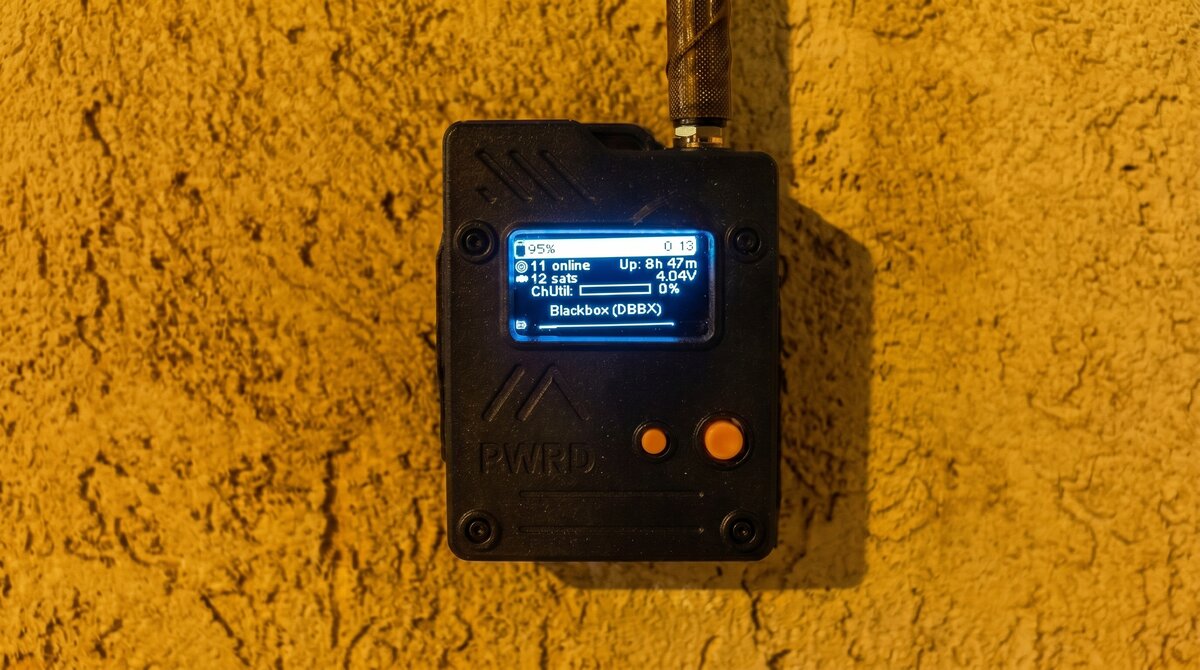
Maybe it’s a good gift for geeks at this point, but I don’t know whether I should give one without asking. And asking feels awkward, too: my friend keeps mentioning how, and I quote, “walkie-talkies are more practical”.
The irony is that the band choice isn’t the fault of Meshtastic: it operates on one of the few bands everyone can actually use and still can’t find anyone. Meanwhile most of the spectrum sits untouched.
My experience made me think a lot because I know what’s out there. For years, across different cities, I’ve been carrying a TinySA Ultra around, sweeping the spectrum in different places from time to time: parks, train stations, random street corners. What strikes me every time is how empty most of it is. Huge stretches of bands sit quiet. Not “a bit underused” quiet: genuinely empty, for hours. Meanwhile, the bands we’re all allowed to share are a crowded mess.
It’s hard not to feel like we could be doing much more with that silence. Right now, chunks of the spectrum get auctioned off country by country, which does bring real money into national budgets: I’m not pretending that’s nothing. And yet, I suspect a bit more room for amateur radio and experimental use would pay off in ways auctions don’t measure: people tinkering, building local networks, learning how RF actually behaves. I know spectrum auctions and carrier economics aren’t going away, but I wonder if reserved amateur/experimental bands could coexist alongside them.
So, to anyone reading this who knows their way around a soldering iron: I really think Wi-Fi HaLow deserves more attention. Nowadays, it’s probably the only long-range wireless system with a realistic shot at being both widely available and legal to deploy casually. I’d love to get my hands on Morse Micro’s MM8102 and MM8108 someday. Long-range Wi-Fi could start to resemble what we had with directed antennas back in the day, and off-grid operation deserves to be a first-class use case, not an afterthought.
The deeper cost isn’t that spectrum sits empty or that Meshtastic has thirty-six nodes across a hundred kilometres. It’s that fewer people each year notice or care why. We’re not just losing tools, but the sense that reaching past the obvious option is worth the trouble. Once that curiosity goes quiet, a library full of documentation doesn’t help much, and the culture of convenience is very good at making curiosity feel like unnecessary effort.
I’d love to hear how others are filling the gaps. If you’ve deployed Meshtastic, Wi-Fi HaLow and / or local mesh, the way to contact me should be pretty obvious.